

Fire alarm system for commercial building planning is one of the most critical safety decisions a business owner or property manager will ever make. Fires do not announce themselves politely. They start quietly, spread fast, and cause damage long before flames are visible. In a commercial environment, where dozens or even hundreds of people may be present, early detection and clear notification can mean the difference between a controlled incident and a devastating loss.
A properly designed fire alarm system for commercial building use does far more than trigger noise. It protects lives, limits property damage, reduces liability, and helps businesses recover faster after an emergency. From office complexes and warehouses to retail spaces and medical facilities, every commercial occupancy faces unique fire risks that demand professional fire safety services and compliant system design.
At FirePro Tech, LLC, we work closely with business owners, facility directors, and property managers across Houston to design and service fire alarm systems that meet real-world operational needs while staying aligned with code requirements. This guide begins by laying the foundation, explaining what a fire alarm system for commercial building environments truly does, how it differs from residential systems, and why fire detection for business operations must be treated as a strategic investment rather than a checkbox.
A fire alarm system for commercial building applications is an interconnected network of detection devices, control equipment, and notification components designed to identify fire-related conditions and alert occupants and responders immediately. Unlike basic alarms, commercial fire alarm systems are engineered to cover larger spaces, higher occupant loads, and more complex layouts.
Commercial buildings often contain multiple hazards such as electrical rooms, kitchens, storage areas, and mechanical equipment. A fire alarm system for commercial building use accounts for these risks by combining automatic detection with manual activation and professional monitoring. This layered approach ensures that a fire alarm for business environments responds quickly, even when buildings are unoccupied.
The primary role of a fire alarm system for commercial building safety is life protection. Early detection gives occupants time to evacuate safely, even in large or multi-story properties. Audible and visual notification devices guide people toward exits and support compliance with accessibility requirements.
Beyond life safety, a fire alarm system for commercial building environments helps protect assets and continuity. Fires that go undetected for even a few extra minutes can destroy equipment, inventory, and infrastructure. For businesses, this often means prolonged downtime, lost revenue, and strained client relationships. Reliable fire detection for business operations minimizes these risks by activating alerts early and triggering emergency response protocols.
FirePro Tech, LLC frequently works with Houston-area businesses that have experienced preventable losses due to outdated or poorly maintained systems. A modern fire alarm system for commercial building use helps organizations meet insurance expectations, reduce liability exposure, and demonstrate a commitment to safety to employees and customers alike.
Commercial building fire alarm systems are fundamentally different from residential alarms in both design and performance. A fire alarm system for commercial building use must monitor larger areas, support multiple zones, and provide detailed information about alarm locations. Residential alarms typically operate independently, while commercial fire alarm systems function as a coordinated network.
Another key difference is system supervision. A fire alarm system for commercial building environments continuously monitors wiring, devices, and power supplies. If a fault occurs, the system alerts maintenance teams before protection is compromised. This level of oversight is essential in commercial fire alarms, where system failure can affect many occupants at once.
Commercial fire alarm systems are also designed to integrate with other life safety components. Elevators, access controls, and HVAC systems may respond automatically when a fire alarm system for commercial building safety is activated. This integration helps contain smoke, support evacuation, and reduce overall risk.
Early fire detection for business operations is not just about alarms sounding quickly. It is about informed response. A fire alarm system for commercial building use provides clear signals that identify where the threat originates, allowing first responders to act decisively.
From a financial perspective, businesses with properly maintained fire alarm systems for commercial buildings often experience lower recovery costs after incidents. Faster response limits fire spread and reduces the likelihood of complete shutdowns. This is especially important for facilities that operate around the clock or store high-value assets.
There is also a reputational component. Customers, tenants, and employees expect safe environments. A visible commitment to commercial fire alarm systems reinforces trust and professionalism. FirePro Tech, LLC helps businesses in Houston design fire alarm systems that align with both regulatory expectations and operational realities, ensuring that safety supports long-term success.
By understanding what a fire alarm system for commercial building use truly entails, decision-makers are better prepared to evaluate system options, compliance requirements, and service partnerships as the guide continues.
Understanding how a fire alarm system for commercial building environments functions helps business owners make informed decisions about design, upgrades, and maintenance. These systems are not a single device but a coordinated process that starts with detection and ends with clear communication to occupants and emergency responders. Every step matters, because delays or failures at any point can compromise safety.
A properly engineered fire alarm system for commercial building use operates continuously in the background. It monitors conditions, supervises its own components, and stands ready to react the moment something abnormal occurs. This constant readiness is what separates commercial fire alarm systems from basic alarms and makes them essential for modern business facilities.
At the core of every fire alarm system for commercial building safety is a structured response sequence. The system first detects a potential fire condition, then determines whether action is required, and finally notifies people and external services. This process happens in seconds but involves multiple components working together.
Fire detection for business environments must account for different hazards across a facility. Offices, kitchens, warehouses, and mechanical rooms all present unique risks. A well-designed fire alarm system for commercial building use balances sensitivity with reliability so that real threats are detected quickly without excessive false alarms.
Initiating devices are the starting point of any fire alarm system for commercial building applications. These include smoke detectors, heat detectors, and manual pull stations placed strategically throughout the property. Each device type serves a specific purpose depending on the environment it protects.
In areas where smoke is the earliest indicator, smoke detectors provide rapid fire detection for business safety. In harsher environments such as kitchens or loading docks, heat detectors are often more appropriate. Manual stations allow occupants to activate the fire alarm system for commercial building evacuation if they see danger before automatic devices respond.
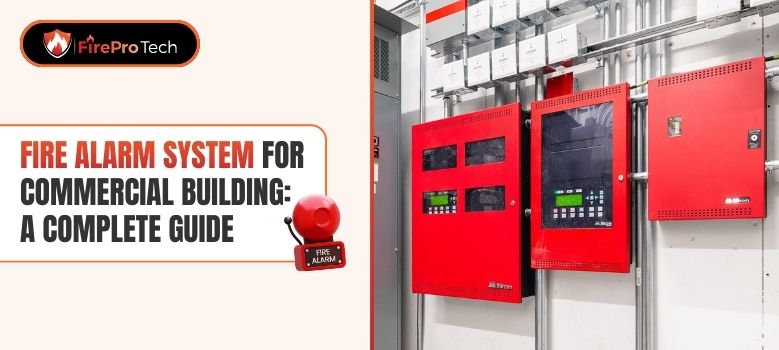
Once a device is triggered, the signal is sent to the fire alarm control panel. This panel acts as the decision-making center of the fire alarm system for commercial building use. It evaluates the signal, identifies its location, and determines which outputs should activate.
Modern commercial fire alarm systems provide detailed information at the panel, allowing responders to pinpoint the source of the alarm quickly. This level of clarity is critical in large facilities, where knowing the exact origin of a fire can save valuable time during response.
After the control panel processes the alarm, notification appliances activate throughout the building. These include horns, strobes, and in some cases voice evacuation systems. The goal of this stage is to ensure everyone is aware of the emergency and understands the need to evacuate.
A fire alarm system for commercial building environments must provide both audible and visual alerts to support diverse occupant needs. Clear notification reduces confusion and panic, helping people exit safely and efficiently. FirePro Tech, LLC emphasizes proper notification design to ensure messages are unmistakable in real-world conditions.
The final step in the process involves communication beyond the building. Many commercial fire alarm systems are connected to professional monitoring services that notify emergency responders immediately when an alarm is confirmed.
Commercial fire alarm monitoring is especially important after hours or in unoccupied buildings. A fire alarm system for commercial building protection does not rely on someone being present to call for help. Instead, it ensures that fires receive attention as soon as they are detected, limiting damage and improving outcomes.
Not every business requires the same type of fire alarm system for commercial building use. System selection depends on factors such as building size, occupancy type, operational needs, and future expansion plans. Understanding the main system categories helps decision-makers choose solutions that provide reliable protection without unnecessary complexity.
Commercial fire alarm systems are designed to be scalable and adaptable. As businesses grow or change, the fire alarm system for commercial building safety should be able to evolve without requiring a complete replacement. This flexibility is a key consideration during system planning.
Conventional systems divide a building into zones, with each zone reporting alarms as a group. This approach can be effective in smaller properties but provides limited location detail. In contrast, addressable commercial fire alarm systems identify each device individually, offering precise information about where an alarm originates.
Wireless options are increasingly used in certain applications, especially where wiring is difficult or disruptive. A wireless fire alarm system for commercial building retrofits can reduce installation time while still delivering reliable performance. FirePro Tech, LLC helps Houston businesses evaluate which approach aligns best with their operational and compliance needs.
Another distinction among commercial fire alarms is how alarms are initiated. Manual systems rely on human activation, while automatic systems depend on detectors to sense fire conditions. Most modern fire alarm systems for commercial buildings use a hybrid approach that combines both methods.
This combination ensures that fires are detected quickly while still allowing occupants to activate the fire alarm system for commercial building evacuation if necessary. Hybrid systems provide redundancy, which is a core principle of effective fire safety services in commercial settings.
Selecting the right fire alarm system for commercial building use requires a clear understanding of how the space is used. High-occupancy buildings, facilities with sleeping areas, and properties with specialized hazards often require more advanced commercial fire alarm systems.
Risk assessment plays a major role in this process. Fire detection for business environments must consider ignition sources, fuel loads, and evacuation challenges. FirePro Tech, LLC works closely with facility teams to design fire alarm systems for commercial buildings that align with real risks rather than generic assumptions.
By choosing the appropriate system type and configuration, businesses create a foundation for long-term safety, compliance, and reliability. The right fire alarm system for commercial building protection is not just a technical solution but a strategic investment in people and operations.
Determining when a fire alarm system for commercial building use is required is not a guessing game. Requirements are driven by building codes, occupancy type, and how a space is used on a daily basis. For business owners and property managers, understanding these triggers helps avoid costly violations and last-minute system upgrades.
In most cases, a fire alarm system for commercial building safety is mandatory long before a facility reaches full occupancy. Codes are designed to anticipate risk, not react to incidents. This is why early planning around commercial building fire alarm systems is essential during construction, renovation, or change of use.
Occupancy classification is one of the first factors that determines whether a fire alarm system for commercial building protection is required. Offices, retail stores, warehouses, healthcare facilities, and assembly spaces all fall under different categories, each with its own expectations for fire detection for business environments.
Square footage and occupant load also play a major role. As buildings grow larger or accommodate more people, the need for commercial fire alarm systems increases. A small tenant space may have limited requirements, while a multi-tenant facility or high-traffic business almost always needs a fully integrated fire alarm system for commercial building compliance.
Use of space matters just as much as size. Areas with cooking equipment, flammable materials, or critical operations often require enhanced commercial fire alarms even if the building itself is modest in scale. FirePro Tech, LLC routinely helps Houston businesses assess how daily operations influence fire alarm system requirements.
The Authority Having Jurisdiction, commonly referred to as the AHJ, has significant influence over whether a fire alarm system for commercial building use is required and how it must be designed. The AHJ interprets adopted codes and applies them to specific properties based on local conditions.
During plan review or inspection, the AHJ may require additional features within commercial fire alarm systems, such as voice evacuation or expanded notification coverage. These decisions are not arbitrary. They are based on life safety concerns unique to each building.
Working with an experienced fire safety services provider simplifies this process. FirePro Tech, LLC coordinates with AHJs throughout Houston to ensure fire alarm systems for commercial buildings meet expectations before inspections occur, reducing delays and rework.
Before designing or upgrading a fire alarm system for commercial building use, accurate documentation is critical. Floor plans, occupancy details, and records of past inspections all influence system requirements. Missing information can lead to design changes that increase cost and extend timelines.
Changes in tenancy or building use should also be documented carefully. A space that once required minimal protection may now need a more robust fire alarm system for commercial building safety due to increased risk or occupant load. Keeping records current allows commercial fire alarm systems to evolve alongside the property.
Designing a fire alarm system for commercial building compliance is both a technical and strategic process. The goal is not only to meet code but to create a system that performs reliably under real-world conditions. Good design considers how people move, how spaces are used, and how emergencies actually unfold.
A well-designed fire alarm system for commercial building environments reduces false alarms, improves response time, and supports long-term maintenance. This stage sets the foundation for everything that follows, from installation to inspections.
Every effective design begins with a thorough site survey. This step evaluates building layout, construction features, and operational hazards that influence fire detection for business environments. Mechanical rooms, storage areas, and tenant spaces all require careful review.
Risk assessment helps determine where detectors, notification devices, and control equipment should be placed. A fire alarm system for commercial building safety must balance coverage with practicality. Overlooking environmental factors such as dust, humidity, or temperature extremes can compromise system reliability.
FirePro Tech, LLC emphasizes detailed surveys to ensure commercial fire alarm systems are tailored to the actual conditions of each Houston property rather than relying on generic layouts.
Proper device placement is central to the effectiveness of a fire alarm system for commercial building use. Detectors must be located where fire conditions are most likely to be identified early, while notification appliances must be visible and audible throughout occupied areas.
Spacing, mounting height, and environmental exposure all influence performance. A poorly placed detector can delay activation, while inadequate notification coverage can leave occupants unaware of danger. Thoughtful placement ensures commercial fire alarms function as intended during emergencies.
Notification design goes hand in hand with egress planning. A fire alarm system for commercial building safety must support orderly evacuation by directing attention toward exits and communicating urgency clearly.
In larger facilities, voice evacuation systems may be required to provide instructions. Visual notification is equally important in environments where noise levels are high or occupants may have hearing impairments. These considerations ensure commercial building fire alarm systems serve all occupants effectively.
The final phase of design involves documentation and coordination. Drawings and calculations must be submitted for approval before installation begins. A fire alarm system for commercial building compliance depends on accurate submittals that reflect code requirements and site conditions.
Coordination with other trades is also essential. Electrical, mechanical, and security systems often intersect with commercial fire alarm systems. FirePro Tech, LLC manages this coordination to prevent conflicts and ensure the fire alarm system for commercial building use integrates smoothly with the rest of the facility.
By addressing requirements and design considerations early, businesses set the stage for a fire alarm system that is compliant, reliable, and built to protect what matters most.
Once the design is approved, the focus shifts to execution. Installation and testing determine whether a fire alarm system for commercial building use performs as intended when it matters most. Even the best design can fall short if installation shortcuts or incomplete testing compromise system reliability.
For business owners, this phase often feels disruptive, but it is also where long-term safety and compliance are locked in. A properly installed fire alarm system for commercial building environments reduces future service issues and supports smoother inspections.
Installation looks different depending on whether the project is a new build or a retrofit. In new construction, the fire alarm system for commercial building safety is typically installed alongside electrical and mechanical systems. This allows for cleaner wiring paths and easier coordination.
Retrofits require more planning. Existing finishes, occupied spaces, and operational schedules all affect how commercial fire alarm systems are installed. Careful phasing helps minimize disruption while ensuring devices are placed correctly. FirePro Tech, LLC regularly installs fire alarm systems for commercial buildings in active Houston facilities by coordinating work around business hours and tenant needs.
After installation, acceptance testing confirms that the fire alarm system for commercial building use operates according to design and code. Every initiating device, notification appliance, and control function is tested to verify proper response.
This process is often witnessed by the AHJ or a designated inspector. Successful testing demonstrates that commercial building fire alarm systems are ready for occupancy. Any deficiencies must be corrected before approval is granted, which is why thorough pre-testing is essential.
A fire alarm system for commercial building safety is most effective when occupants and staff understand how it works. Basic training helps facility teams recognize alarm conditions, respond appropriately, and reset systems when authorized.
Staff awareness also reduces unnecessary service calls and confusion during drills or real events. FirePro Tech, LLC provides guidance so building personnel know how to interact with commercial fire alarm systems confidently and responsibly.
Installation is not the end of the journey. Ongoing monitoring and maintenance keep a fire alarm system for commercial building protection reliable year after year. Fire safety is not static, and systems must adapt to changes in occupancy, layout, and use.
Regular service ensures that commercial fire alarm systems continue to meet code requirements while providing dependable protection for people and property.
Commercial fire alarm monitoring connects the fire alarm system for commercial building use to a supervising station that responds to alarms around the clock. When a signal is received, responders are notified immediately, even if the building is unoccupied.
This layer of protection is critical for businesses that operate outside normal hours or store valuable assets. A fire alarm system for commercial building environments paired with monitoring reduces response time and limits damage during off-hours incidents.
Routine inspection and testing are required to keep commercial building fire alarm systems compliant and functional. These activities verify that detectors remain sensitive, notification devices operate correctly, and control equipment communicates as expected.
A structured maintenance plan helps businesses avoid lapses that could lead to violations or system failure. FirePro Tech, LLC works with Houston clients to schedule inspections that align with operational needs while maintaining consistent fire protection.
Over time, components wear out or become damaged. Prompt service keeps a fire alarm system for commercial building safety from degrading unnoticed. Addressing minor issues early prevents larger failures that could leave a facility unprotected.
Service history also matters during inspections. Well-documented maintenance demonstrates that commercial fire alarm systems are actively managed rather than ignored until problems arise.
Modern facilities often connect fire alarm systems for commercial buildings with broader commercial fire and security systems. Access control, surveillance, and emergency communication tools can all respond automatically when an alarm is activated.
This integration enhances situational awareness and supports coordinated response. A fire alarm system for commercial building use becomes part of a larger safety ecosystem rather than a standalone device. FirePro Tech, LLC helps businesses design integrated solutions that improve protection without adding unnecessary complexity.
Through proper installation, testing, monitoring, and maintenance, a fire alarm system for commercial building environments remains a dependable safeguard that evolves alongside the business it protects.
Read Also: Choose Right Business Fire Alarm Systems for Your Company
A fire alarm system for commercial building safety is not just a regulatory requirement. It is a core part of how businesses protect people, property, and long-term operations. From early fire detection for business environments to coordinated evacuation and emergency response, these systems work quietly in the background until the moment they are needed most.
Throughout this guide, it becomes clear that a fire alarm system for commercial building use must be planned, designed, installed, and maintained with intention. Each phase builds on the next. When any step is rushed or overlooked, the entire system becomes less effective. This is why professional fire safety services matter, especially for complex commercial building fire alarm systems.
FirePro Tech, LLC partners with business owners and facility leaders across Houston to deliver commercial fire alarm systems that are code-compliant, reliable, and built for real-world conditions. By investing in the right fire alarm system for commercial building environments and maintaining it properly, businesses create safer spaces for employees, customers, and tenants while protecting their operational future.
The best fire alarm system for commercial building use depends on the size of the property, occupancy type, and specific risks present. Some facilities benefit from addressable commercial fire alarm systems that provide detailed location information, while others may require voice evacuation or specialized detection. FirePro Tech, LLC evaluates each building individually to recommend a fire alarm system for commercial building safety that aligns with operational needs and code requirements rather than offering a one-size-fits-all solution.
Not every property has identical requirements, but most commercial occupancies do require a fire alarm system for commercial building compliance at some level. Factors such as square footage, occupant load, and use of space determine what is required. Fire detection for business environments is often mandatory even in smaller facilities when specific hazards are present. Working with experienced fire safety services helps clarify requirements before violations occur.
A fire alarm system for commercial building protection must be inspected and tested on a regular schedule defined by code and local enforcement. These inspections ensure that commercial fire alarm systems remain functional and ready to respond. FirePro Tech, LLC helps Houston businesses stay compliant by coordinating inspection and testing plans that fit operational schedules while maintaining safety.
Commercial fire alarm monitoring connects a fire alarm system for commercial building use to a supervising station that responds to alarms at all times. This service is especially important when buildings are unoccupied or operate after hours. While not always mandatory, monitoring significantly improves response time and reduces damage, making it a valuable component of modern commercial fire alarm systems.
Yes, a properly installed and maintained fire alarm system for commercial building safety can reduce insurance risk by demonstrating proactive fire protection. Insurers often look favorably on businesses with reliable commercial fire alarms and documented maintenance. Fire detection for business operations shows a commitment to loss prevention and may influence coverage terms.
False alarms often occur due to poor device placement, lack of maintenance, or environmental factors such as dust or steam. A well-designed fire alarm system for commercial building use minimizes these issues through proper planning and regular service. FirePro Tech, LLC focuses on long-term reliability to help businesses avoid unnecessary disruptions caused by false activations.
Many modern fire alarm systems for commercial buildings can integrate with commercial fire and security systems. Access control, cameras, and emergency communications can respond automatically when alarms activate. This integration improves situational awareness and supports coordinated response during emergencies, especially in large or complex facilities.
The lifespan of a fire alarm system for commercial building environments depends on component quality, maintenance, and changes in code or building use. While systems can last many years, upgrades are often needed as technology advances or occupancy changes. FirePro Tech, LLC helps businesses plan for upgrades that keep commercial fire alarm systems effective without unnecessary replacement.
Fire safety is a major concern for business owners in Houston and surrounding communities, where...
In Houston and nearby areas, a thorough fire code inspection is more than just a...
Ensuring fire safety in Houston and surrounding areas begins with understanding the essential fire extinguisher...